

Full-time

Sports Facilities

The NCHU Sports Facilities Management Regulations provide details (including application procedures and a fee schedule) for renting sports venues at the University (including the gym, sports field,, swimming pool, outdoor basketball courts, and outdoor volleyball courts) as well as usage guidelines and notices for each venue. The regulations also contain information on the available hours of all sports facilities during school semesters and summer/winter vacations.

Physical Education

Each student may take up to one physical education (PE) course of their choice per semester. Daytime undergraduate students may not select PE courses designated for continuing education undergraduate students, and vice versa. Please select PE courses via the academic system within the course selection period stipulated by the Division of Curriculum. Students admitted in or after Academic Year 2022–23 must take two semesters of PE courses before graduation, with up to two additional PE credits counting toward a student’s graduation credits (only if permitted by the student’s department). The University also offers Interaction Adjustment courses for students who are unable to take part in regular PE courses. Transfer students, readmitted students, and students who have been approved to take PE courses at another institution domestically or abroad, may apply to transfer PE credits within the application period stipulated by the University. Please refer to the course selection notice for matters related to clothing requirements for PE classes and other course-specific regulations.
Externally-funded research projects—NSTC Subsidy Program for Graduate Students Attending International Scholarly Conferences

Doctoral and master’s degree students studying at the University (excluding in-service programs) are eligible to apply:

    • Online application documents include but are not limited to the following:
    1. An application form
    2. Proof of paper acceptance
    3. Abstract of the accepted paper
    4. A letter of recommendation signed by the advisor (please indicate the applicant’s foreign language proficiency)
    • Applicants must submit their application by 3 p.m. on the first day of the month preceding the start of the conference. The University will compile submitted applications and forward them to the NSTC by 5 p.m. on the same day.
    • The subsidy is limited to one person per paper (whether presented orally or in the form of a poster).
    • The subsidy covers flights and conference registration.n- Subsidies must only be used for their designated purposes. Except in the event of revocation, requests for changes must be made via the online system prior to the conference and will only become effective upon approval by the NSTC.
    • Conferences held in mainland China must be organized by an international academic organization (or chiefly organized by an international academic organization and co-organized by mainland China).
    • Each person may receive one subsidy per fiscal year. Those who have already received a subsidy may not apply for any other further international conference subsidies as a graduate student or otherwise in the same academic year.
    • Subsidy recipients must submit a conference report and account settlement form to the NSTC’s system within 15 days of the conference’s conclusion in order to file for reimbursement.

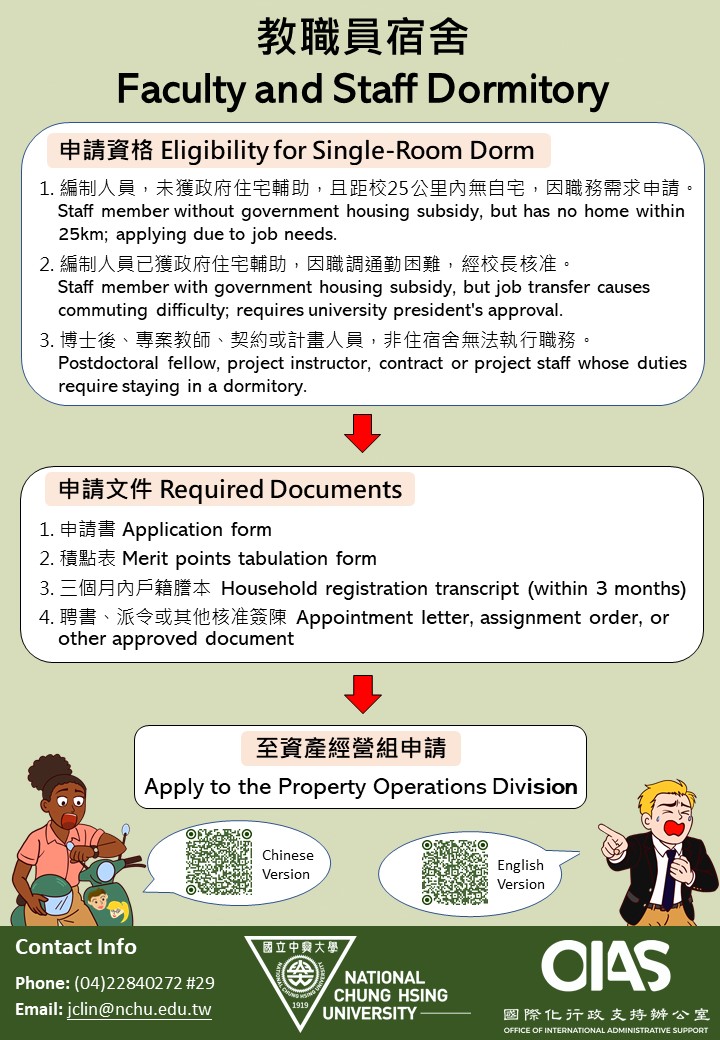
Faculty and staff dormitories

Eligibility:

Staff members who have no residence within 25 km of campus, or who face commuting difficulties due to job transfer and have obtained approval.
Postdoctoral researchers, project faculty, contract or project staff whose duties require on-campus residence.

Faculty and staff members must submit the following documents to apply for employee dormitories:

A completed application form
A merit points tabulation form
A household registration transcript issued within three months (must be located beyond a 25 km radius of the University)
A certificate of appointment, letter of assignment, or other proof of approval

Tuition and Fees

The tuition and fee schedule will be posted on the official NCHU website and may be paid through a variety of means. Students can follow the provided link to navigate to the First Bank’s E-school Payment Gateway to confirm and settle the amount due.

School Cafeteria

The school cafeteria is operated by a contractor that offers a variety of dining options, including an à la carte buffet, themed restaurants, a fast food place, and a convenience store. The cafeteria is a great place to hang out with other faculty members, students, and people from neighboring communities.

International collaborations-Partner Universities

Pursuant to the University’s Principles for Signing Collaborative Agreements with Higher Education and Research Institutions, any entity with which NCHU signs an agreement must be carefully selected. Such entities must be of a similar scale as the University, be conducive to the academic development and improvement of the University, and be willing to collaborate with the University in a mutually beneficial manner. Contract terms, regardless of scope, items, or level of collaboration, must undergo an internal review process before an agreement may be signed. Please visit the Office of International Affairs website for the contract formats and contact the Office for consultation on any potential collaboration opportunities.

International collaborations-Receiving international guests

To facilitate international academic exchanges, the University provides the following resources for visiting international guests: Short-term visiting ID (Office of International Affairs), University promotional videos/materials (Secretariat Office), contracted hotels (General Affairs Office-approved contractors), NCHU-branded souvenirs (Caves Books), etc. Please contact the Office of International Affairs’ Division of Academic Exchange for guests invited by a university-level unit.

Emergency Relief Funds

1. Students who face any of the following emergencies during their period of study at the University may be eligible for emergency relief funds:

  (1) Hospitalization for an injury or illness when unable to pay for medical expenses due to financial hardship;

  (2) A major familial incident resulting in financial hardship;

  (3) Death;

  (4) Other incidents that require emergency relief.

2. To apply for emergency relief funds, the affected student or their advisor should fill out the application form and submit it along with the necessary supporting documents to the department chair/institute director and college dean for signing. Applications will be reviewed by the Office of Student Affairs’ Division of Student Life, which shall then forward them to the University’s President for approval.

3. Emergency relief funds of up to NT$30,000 may be released once per incident. The NCHU Student Emergency Relief Funds Application Guidelines and application form are available for download on the Division of Student Life website.

Externally-funded research projects—NSTC research projects

1.  All principal investigators and co-investigators must be quota-based, full-time personnel of the University.

2. The three types of research projects are as follows:

    • General research projects: The application period is in November–December each year. Exact dates will be announced by the NSTC.
    • New personnel research projects: Projects led by a domestic/international teacher or researcher who has fewer than five years of teaching/research experience or who has graduated with a doctoral degree in the past five years are eligible. Applications for such projects should be made upon the initial appointment date or within three years of the conferral of the doctoral degree and will be reviewed on an ad hoc basis. Limit one project per person.
    • Call-for-proposal projects: Please refer to announcements made by the NSTC.

3. Virement under an same approved budget may be processed in accordance with applicable regulations based on actual needs.

4. All principal investigators and researchers must complete at least six hours of academic ethics training.